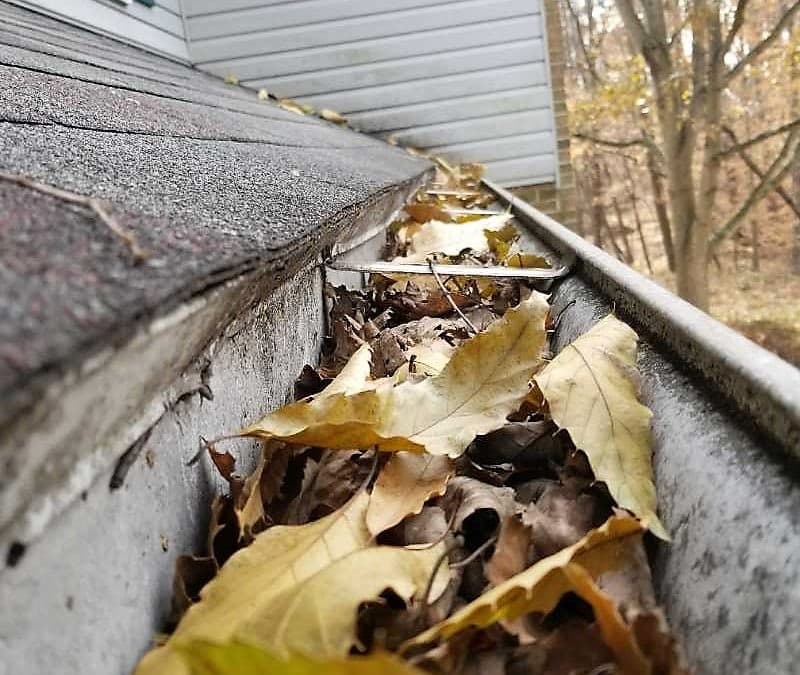
Every year in New Zealand, hundreds of people end up in emergency departments after falling from ladders during home maintenance. Cleaning gutters is one of the most common causes. It's a task that looks simple — grab a ladder, scoop some leaves — but it combines height, awkward body positions, wet surfaces, and often no one else around to help. Ground-based gutter cleaning exists specifically to remove that risk, and it's worth understanding why the difference matters.
The ladder problem isn't about skill — it's about physics
People who fall from ladders aren't usually being careless. The problem is that cleaning gutters is physically awkward. You're reaching sideways or overhead, often with wet gloves, while standing on a surface that can shift. The ladder has to be moved repeatedly along the length of the house, which means climbing up and down multiple times. Every transition is a risk point.
Add in a sloped driveway, soft ground, or a two-storey home, and the difficulty compounds quickly. WorkSafe New Zealand consistently lists falls from height as a leading cause of serious injury in home environments. Gutter cleaning sits squarely in that category.
Two-storey homes are a different level of risk
On a single-storey home, a fall from a ladder might result in a broken wrist or ankle — serious, but survivable. On a two-storey home, the height is typically six to eight metres. A fall from that height carries a high risk of fatal or life-changing injury. Yet people attempt it with standard extension ladders all the time, often on their own.
Even professionals who work at height regularly follow strict protocols: correctly rated ladders, proper footings, a second person holding the base, safety equipment for anything above a certain height. For a homeowner doing it occasionally, those protocols are rarely in place.
If you have a two-storey property, two-storey gutter cleaning done from the ground isn't just a convenience — it's genuinely the right call from a safety standpoint.
Roof surfaces add another layer of hazard
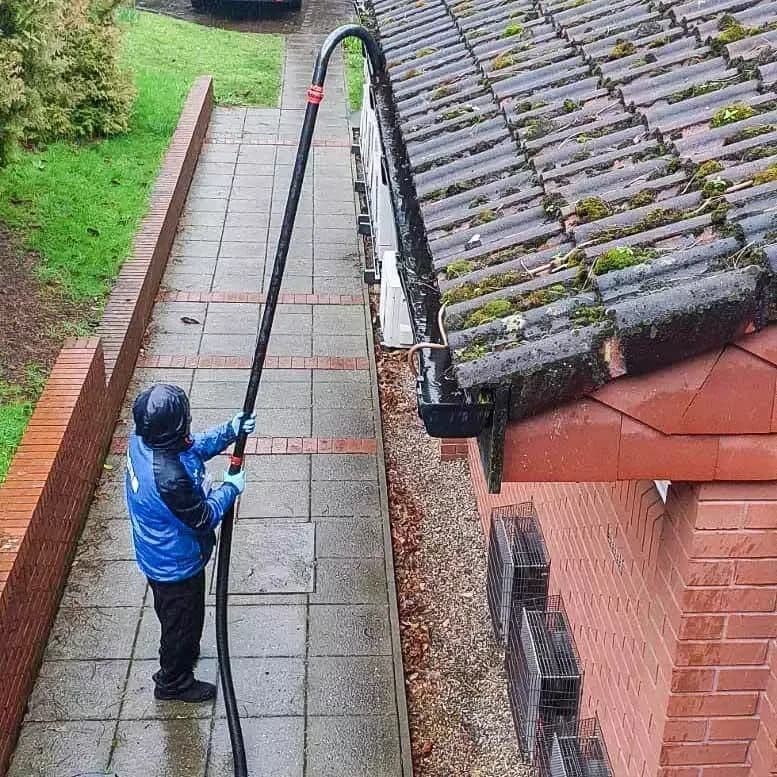
Some people bypass the ladder issue by climbing onto the roof to access gutters from above. This is often more dangerous, not less. Roof surfaces — especially metal roofs, which are common on Waikato homes — become extremely slippery when wet. Moss and lichen, which build up quickly in our damp climate, make the problem worse. There's no good foothold, the pitch works against you, and if you go over the edge, there's nothing to stop you.
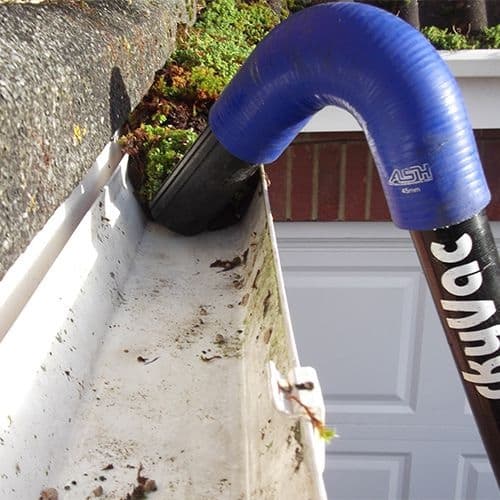
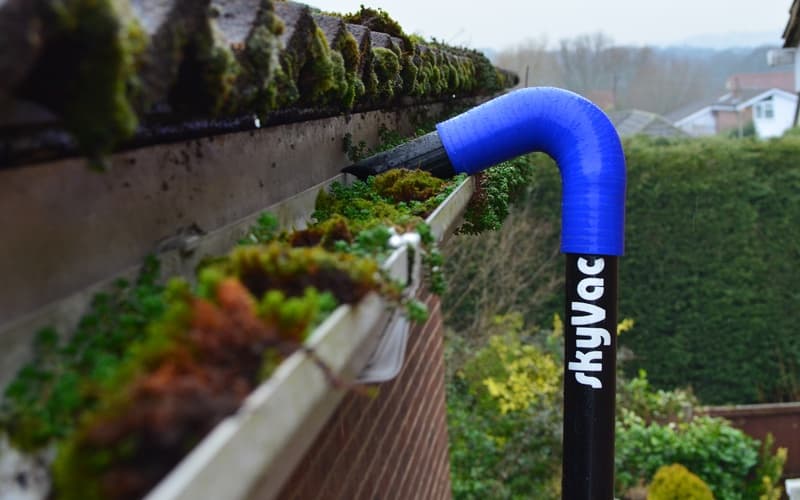
A ground-based vacuum system doesn't require any roof access at all. The pole extends to reach the gutter from the ground, and the debris comes out into a collection unit rather than onto the lawn or into the downpipes.
How the SkyVac approach removes the hazard
The SkyVac 85 we use is built specifically for this purpose. Carbon-fibre poles extend to reach gutters on homes up to three storeys high — the operator stays on the ground throughout. There's no ladder involved at any point in the job.
- A powerful industrial vacuum draws debris — leaves, silt, moss, seed pods — out of the gutter and into a sealed collection unit.
- A camera mounted on the pole head lets the operator see inside the gutter in real time, so nothing is missed and the job can be verified.
- Downpipe blockages can be identified and cleared without removing downpipes or going anywhere near the roof.
- The whole process is cleaner than manual scooping — debris doesn't end up on the garden, the driveway, or the roof.
For a deeper look at how the system works step by step, see our article on how the SkyVac gutter vacuum works.
Safety matters for DIYers and tradespeople alike
The conversation about ladder safety sometimes gets framed as being about homeowners doing dodgy DIY. But experienced tradespeople fall from ladders too. The risk doesn't disappear with familiarity — it can actually increase, because experience can lead to taking shortcuts that seem fine right up until they're not.
Ground-based cleaning sidesteps the argument entirely. If the operator never needs to leave the ground, the question of ladder safety becomes irrelevant. That's a better outcome than making sure your ladder is properly rated, correctly positioned, and held at the base — all of which still leave risk on the table.
What ground-based cleaning doesn't sacrifice
A reasonable question is whether ground-based cleaning actually does as good a job as getting up close to the gutter manually. The answer is yes — and in some respects better. The camera gives a clearer view of the gutter condition than a person peering over the edge of a ladder. The vacuum extracts debris that manual scooping leaves behind. And because the operator can move freely along the length of the house without repositioning a ladder, the job is often faster too.
The only thing ground-based cleaning trades away is the risk. That's a good trade.
The bottom line
Gutter cleaning is necessary maintenance — but it doesn't have to be dangerous maintenance. For Waikato homeowners, the choice is straightforward: spend time on a ladder doing a job that carries real injury risk, or book a professional service that does it better from the ground. If you'd like to get yours sorted safely, get in touch and we'll book you in.