When people hear 'gutter vacuum' for the first time, they often picture something like a giant leaf blower. The reality is more interesting — and a lot more effective. The SkyVac 85 is a purpose-built industrial system designed specifically for cleaning gutters from the ground, with a camera built in so the operator can see exactly what's happening inside the gutter channel at every point. Here's how it works.
The core components
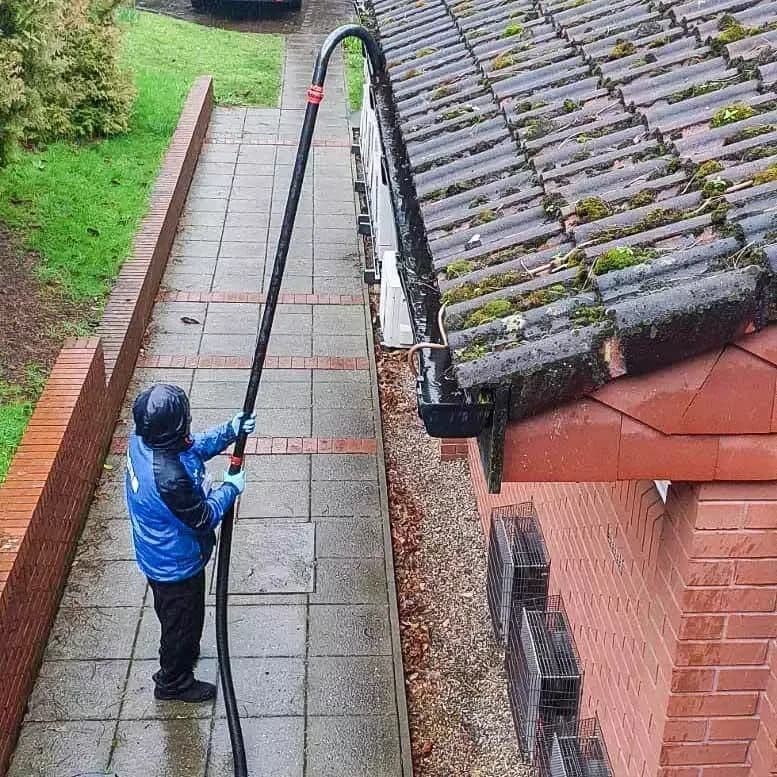
The SkyVac 85 system has three main parts working together: a high-powered vacuum unit, a set of lightweight carbon-fibre poles, and a pole-mounted camera with a live feed. Each part has a specific job, and together they make it possible to thoroughly clean gutters on homes up to three storeys high without anyone leaving the ground.
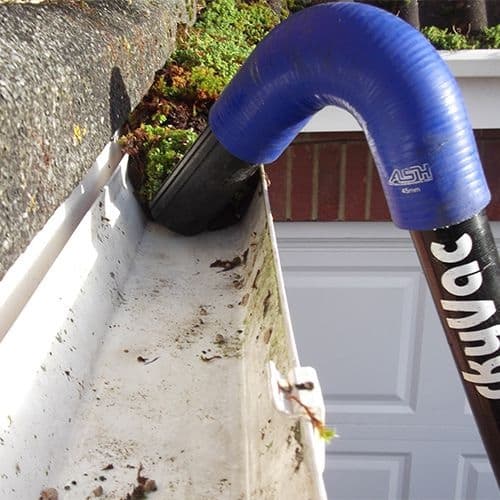
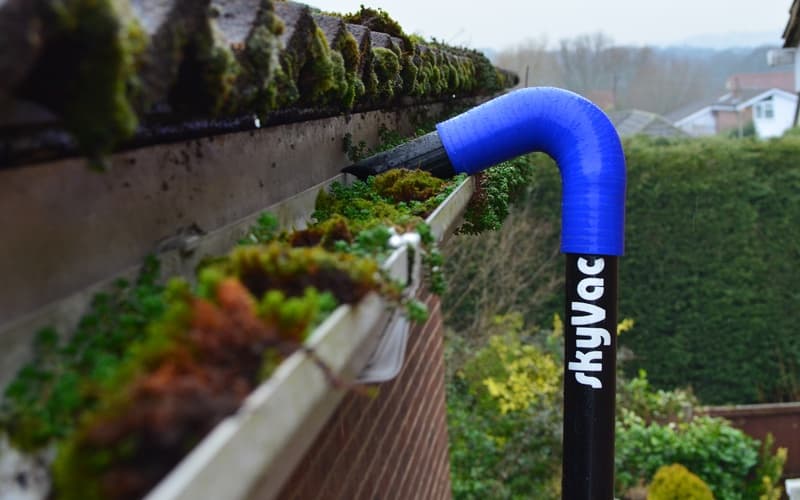
- The vacuum unit: A powerful industrial-grade vacuum that creates enough suction to draw wet leaves, compacted silt, seed pods, and moss out of the gutter channel and through the pole system into a sealed collection bag. This isn't a domestic vacuum — the suction is designed to handle the kind of dense, wet material that builds up in gutters over a full season.
- Carbon-fibre poles: Lightweight but rigid sections that connect to extend the reach. Carbon fibre is used because it's strong enough to handle the suction load and stiff enough to direct the nozzle accurately, while still being light enough for an operator to manoeuvre at full extension. The poles reach up to around ten metres — enough for most three-storey homes.
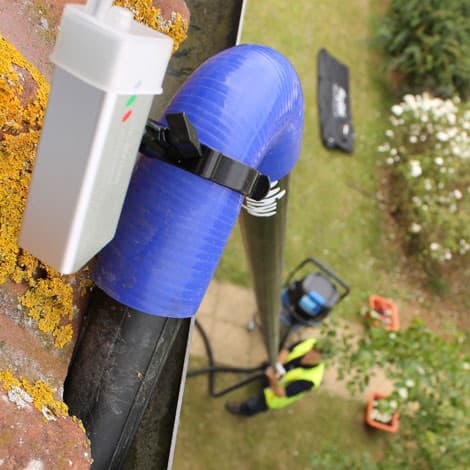
- The camera head: A compact camera mounted on the pole head transmits a live feed to a screen held by the operator. This is what makes the SkyVac different from a standard gutter vacuum — the operator can actually see inside the gutter in real time, spotting blockages, checking corners and downpipe inlets, and verifying the gutter is clear after each section.
Step by step: how a job runs
A typical gutter vacuum cleaning job follows a consistent process from arrival to finish:
- The operator sets up the vacuum unit and assembles the pole system to the right length for the roof height.
- Before starting, the camera is used to do a quick inspection of the gutter condition — this gives a picture of what's in there and flags anything that needs particular attention (heavy compaction near a downpipe, a cracked section, or a blocked inlet).
- Working from one end of the house to the other, the operator guides the nozzle along the gutter channel. The vacuum draws debris up through the pole and into the collection unit. Wet or compacted material that a brush might push around gets lifted clean out.
- At downpipe inlets, the camera confirms whether the inlet is clear. If there's a blockage at the top of the downpipe, it can usually be cleared with the vacuum without needing to remove the downpipe.
- Once each run is finished, the camera does a post-clean check of the gutter. This is what allows us to give customers a genuine condition report rather than just saying 'looks fine'.
- The debris collected goes into a sealed bag that leaves the site with us — nothing ends up on the garden or the lawn.
Why the camera changes everything
Before systems like the SkyVac, the only way to know whether a gutter was clear was to look over the edge — which meant getting up on a ladder or a roof. Even then, you could only see the section directly in front of you, and corners, downpipe inlets, and long runs were hard to inspect thoroughly.
The live camera feed changes that completely. The operator can guide the camera into corners, angle it to look down into downpipe inlets, and check behind debris that's been cleared to make sure nothing's been missed. It turns a guessing job into a verifiable one. Customers can see the footage too — before and after — which is useful when you want to understand the condition of your gutters rather than just trust that the job's been done.
How it compares to manual cleaning
The traditional method of gutter cleaning involves a ladder, a bucket, and a scoop — or a person on the roof with a brush. Both methods have the same fundamental problem: they require working at height, which carries real injury risk. But there are also practical limitations.
- Mess: Manual scooping deposits debris on the ground, the garden, or the driveway. Vacuuming takes it away cleanly.
- Coverage: A person on a ladder can only clean the section within arm's reach, then has to move and reposition. The vacuum pole moves continuously along the gutter run.
- Wet material: Wet, compacted leaves are hard to scoop cleanly. The vacuum handles them well regardless of moisture content.
- Downpipes: You can't scoop a blocked downpipe clear. The vacuum can reach into the top of most downpipes and draw blockages out.
- Verification: Manual cleaning relies on the operator's eye. The camera gives an objective view before and after.
What the SkyVac 85 handles
The '85' in the name refers to the vacuum's capacity. It's sized for residential and light commercial work — single-storey, two-storey, and three-storey homes are all within range. We use it on everything from small townhouses in Hamilton to older two-storey homes in Te Awamutu with long, established gutter runs and heavy leaf loads.
If you have a two-storey property, the system reaches comfortably without needing to step off the ground. That's especially useful for homes with difficult access — steep driveways, soft ground, or sections where a ladder simply can't be safely positioned.
What happens to the debris
One of the things customers notice is that there's nothing to clean up after. With manual gutter cleaning, debris ends up somewhere — on the grass, in the garden beds, scattered down the driveway. The vacuum collects everything into a sealed bag that we take away when we go. The garden looks the same as when we arrived.
Why we chose this system
There are simpler and cheaper ways to clean gutters. We chose the SkyVac because it's the most thorough option available at residential scale, it keeps our operator safe, and it gives customers a verifiable result rather than a promise. For a job that's easy to do badly and easy to skip, having a system that produces consistent, visible results matters.
If you'd like to see what your gutters are actually like inside, or if it's been a while since they were properly cleared, get in touch for a free quote. We cover the whole Waikato — Hamilton, Cambridge, Te Awamutu, Morrinsville, and everywhere in between.