Most people think about their gutters when they're thinking about water problems, and that makes sense — it's the part you can see from the ground. But a blocked downpipe can cause just as much trouble as a blocked gutter, sometimes more. The downpipe is the vertical section that takes water from the gutter and gets it away from the house — if that's blocked, it doesn't matter how clear your gutters are. The water has nowhere to go and backs up anyway.
What causes a downpipe to block?
Downpipes block for a few different reasons, and knowing which one you're dealing with helps to fix it properly rather than just temporarily.
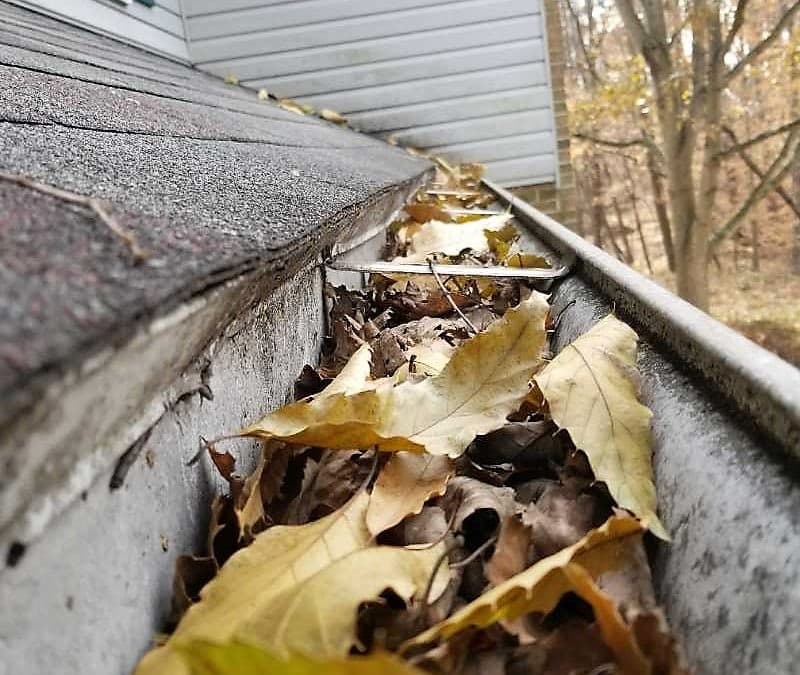
- Leaf and debris accumulation at the downpipe entrance — the top of the downpipe where it meets the gutter is a natural collection point. Leaves, seed pods and twigs funnel in and gradually compact into a plug. This is the most common cause
- Silt build-up mid-pipe — fine organic material washed in over the years settles in bends and offsets in the pipe, gradually reducing the bore until flow stops entirely
- Tree root intrusion — in older underground sections, tree roots can enter through joints and grow to block the pipe. This is harder to clear and may need the underground section replaced
- Tennis balls, roof moss and foreign objects — less common but not unusual; objects that blow onto the roof occasionally end up in the downpipe
- Crushed or collapsed underground section — older clay or PVC underground drain lines can be crushed by vehicles, settling soil or root growth, blocking the pipe physically rather than biologically
How to tell if your downpipe is blocked
A blocked downpipe often shows itself through the gutter rather than directly. Because water can't exit at the downpipe, the gutter fills up and overflows at the nearest low point — which is often not directly above the blockage. This can make it look like the gutter is blocked when actually the problem is lower down. Signs to look for include:
- Gutters overflowing even though they look relatively clear
- Water spilling over the gutter edge right next to a downpipe in heavy rain
- No water coming out of the downpipe discharge point during or after rain
- A gurgling sound from inside the downpipe during rain, suggesting water is slowly draining past a partial blockage
- Soil erosion or green/damp patches on the ground near the downpipe base, suggesting a slow underground leak
If you're not sure whether the problem is the gutter or the downpipe, it's worth getting both checked at the same time. We look at downpipe flow as part of every gutter cleaning we do.
How the SkyVac 85 clears blocked downpipes
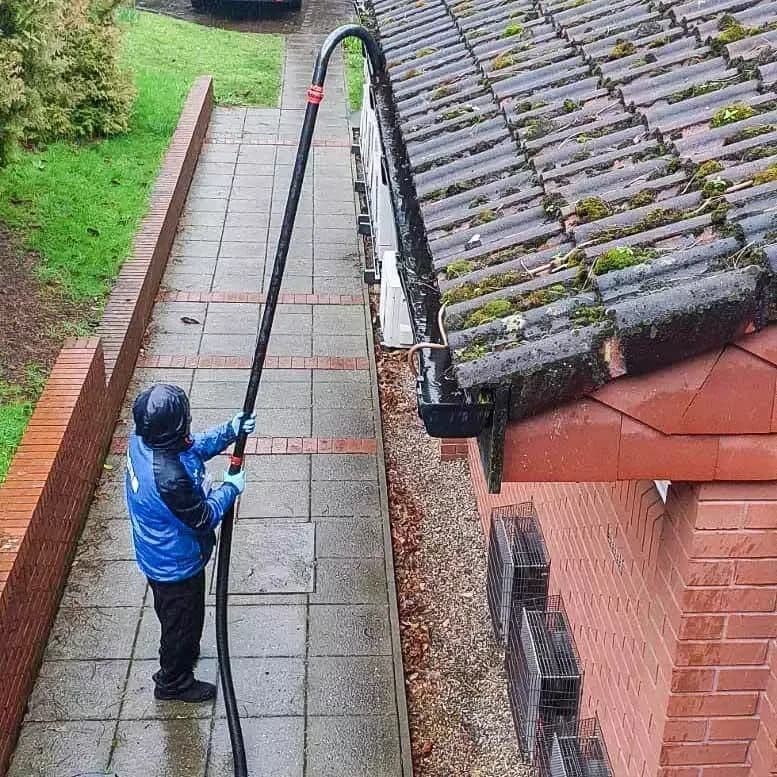
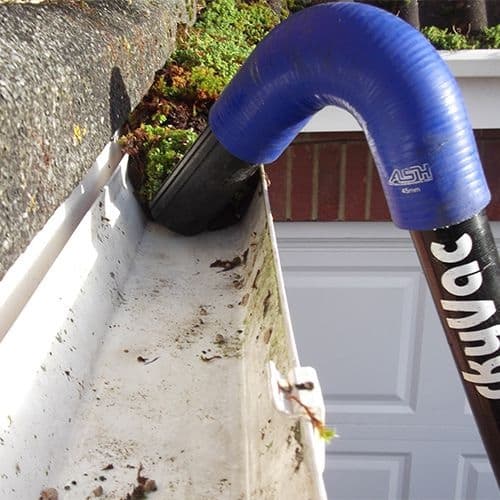
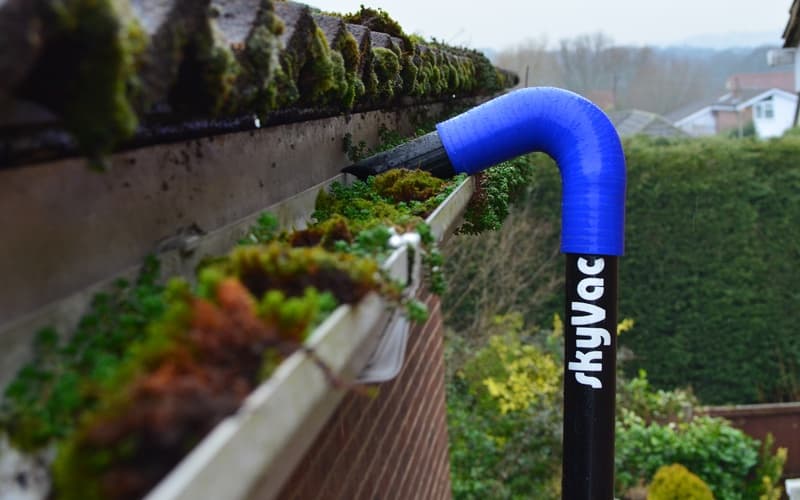
The SkyVac 85 is an industrial-grade gutter vacuum system that generates very high suction — significantly more than a standard wet/dry vacuum. That power is what makes it effective on downpipe blockages that a lighter system or garden hose can't shift. We feed the hose down from the top of the downpipe and the vacuum pulls the material — compacted leaves, silt, debris — up and out into the collection system. Because it's removing material rather than just pushing it further down, it's a more complete fix than water jetting in many cases.
For blockages lower down in the pipe (particularly near bends and offsets), the hose reaches further than most people expect. The SkyVac system can also approach from the bottom of the downpipe where the discharge meets the drain, working upward if the top approach isn't clearing the blockage. You can read more about how the SkyVac vacuum system works if you're interested in the detail.
What about underground drains?
Downpipes typically connect to underground stormwater drains at the base, and that underground section can block independently of the above-ground pipe. Signs of an underground blockage are similar — no flow at the outfall, water bubbling back up around the downpipe base, or damp soil that doesn't dry out after rain. Underground blockages sometimes need a drain camera to identify exactly what's happening, and in some cases (root intrusion, collapsed sections) the drain itself needs relining or replacing. If we clear the visible downpipe and it's still not flowing freely, we'll tell you what we suspect and what the next step should be.
Preventing downpipe blockages
The most reliable way to prevent downpipe blockages is to keep the gutters clear — if debris doesn't build up in the gutter channel, far less of it makes it to the downpipe. Regular gutter cleaning on a once or twice yearly schedule is the main tool. Downpipe strainers (mesh baskets that sit at the top of the downpipe inside the gutter) can help filter out debris before it enters the pipe, but they need to be cleared regularly or they create a blockage at the gutter level instead. They're useful on properties with heavy leaf fall but only if you're checking them.
For properties that have had repeated downpipe blockages, it's worth also checking whether the underground drain is graded correctly and clear — a slow-draining underground section causes silt to build up in the downpipe above it over time.
When to get it checked
If you've noticed your gutters overflowing despite looking relatively clear, or if you can't hear any water flow from your downpipes during rain, it's worth getting it looked at before winter arrives. Blocked downpipes under heavy rainfall move a lot of water in the wrong direction very quickly. We include a downpipe check as part of our standard gutter clean, so if you're due for a clean anyway it's a good opportunity to get the whole system checked in one visit.
Get in touch for a free quote and we'll get the gutters and downpipes sorted before they become a problem.